К содержимому
learnspaceYOUR NEXT CHAPTER
ПРОСТРАНСТВО ОБУЧЕНИЯ
ГлавнаяКаталог курсовМоё обучениеCoursera

Знания без границ

Учитесь у лучших университетов и компаний мира.

Открыть Coursera
Интеграция
Пространство университета
Моё пространствоСтраница курса
↵
ЯЛичный кабинетСтудент
© 2026 LearnSpaceКаждый день — возможность узнать больше.Помощь
The Sun and the Total Eclipse of August 2017 · LearnSpace
Назад в каталог
courseraИнженерия

The Sun and the Total Eclipse of August 2017

Курс от University of Colorado Boulder
Начальный≈ 10.3 чАнглийский
О курсеНавыкиПрограммаПреподаватели

О курсе

A total eclipse is one of the most spectacular sights you can ever see! It looks like the end of the world may be at hand. There is a black hole in the sky where the sun should be. Pink flames of solar prominences and long silver streamers of the sun's corona stretch across the sky. It gets cold, and animals do strange things. People scream and shout and cheer, and remember the experience their whole life. But total eclipses are important scientifically as well. They let us see parts of the sun’s atmosphere that are otherwise invisible. A total eclipse presented the first chance to test Einstein’s prediction that matter can bend space – like near a black hole. The best total eclipse in the United States in 40 years happens August 21st, 2017. This course has two primary goals: 1) to get you excited for the total solar eclipse coming in August 2017 and prepare you and your community to safely view it 2) to provide an inviting overview of the science of the sun and the physics of light If you are most interested in preparing for the eclipse, you can hop right into Week 5! If you want the full course experience, and to get some fun scientific context for what you'll be seeing on August 21st, start with Week 1 and move through the course week by week! [Note: if you start with Week 1, you can skip through some of the repeated material once you get to Week 5.] Overall this course will prepare you to... * Safely view the total or partial solar eclipse * Help others watch safely and even make money by leading a “neighborhood watch” of the eclipse * Review fundamental sun science, including the physics of light, how astronomers study the sun, how it formed, how we know what’s inside it, and where the energy that supports life on earth is generated

Навыки, которые вы освоите

PhysicsScientific MethodsScientific VisualizationEnvironmentPhysical SciencePersonal protective equipmentelectromagneticsSafety AssuranceResearchScience and ResearchGeneral Science and ResearchEnergy and Utilities

Программа курса

5 модулей · 50 учебных материалов

01Introduction to the Sun and Eclipses12 материалов

Introduction to an awesome event people remember their whole lives: a total eclipse of the sun. Get ready for Aug. 21, 2017 !

Course Updates and Accessibility SupportЧтениеMeet astronomer Doug DuncanВидео1. Description and video of a total eclipse - watch people and animals freak out!Видео2. How to watch an eclipseВидео

Учитесь у экспертов

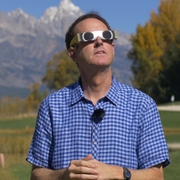
Douglas Duncan

Astronomer, Director, Fiske Planetarium

The Sun and the Total Eclipse of August 2017
В каталоге вашей программы

Инвестируйте в себя

Новые знания — в удобное для вас время.

Начать на Coursera

Обучение откроется на Coursera
в новой вкладке

Обучение на Coursera

≈ 10.3 ч

5 модулей

Язык: Английский

Субтитры: Арабский, Французский, Украинский, Китайский (Китай), Греческий, Итальянский, Бразильский португальский, Нидерландский, Корейский, Немецкий, Русский, Тайский, Индонезийский, Шведский, Турецкий, Испанский, Хинди, Японский, Казахский, Польский

Часть программы вашего университета

Overview of the course topics and goals

3. Overview of Course Topics and GoalsВидео

Total and Partial Eclipses

4. Eclipses of the sun.Видео5. Total vs. partial eclipsesВидео

How astronomers study the sun; the enormous size of the sun.

6. How Astronomers Study the Sun. The Sun's size compared with earth.Видео

Sunspots and the solar activity cycle

7. Sunspots and the solar activity cycleВидео

Assignment for Week 1

Week 1 QuizЗаданиеYou can start final project now!ЧтениеWhat will YOU be doing on eclipse day?!Обсуждение
02Most of what we know about the Sun is learned from Light10 материалов

Why we mostly study the sun with different kinds of light; properties of light.

1. Why we mostly study the sun with different kinds of light, rather than spacecraft.Видео2. What is light? Differences between red, blue, ultraviolet, and X-ray light.Видео3. Properties of light. White light. Kirchhoff-Bunsen laws. How color tells you temperature.Видео4. Don’t be fooled by reflected light!Видео

The strange quantum nature of light

5. Is light a Wave? Is it a particle? It’s both! The strange world of quantum physics.Видео6. Spectrum lines – how they tell us what the sun is made of; the quantum origin of spectrum lines.Видео

How visible light, ultraviolet, X-rays reveal the sun’s photosphere, chromosphere, and corona. Magnetic fields and the solar wind.

7. How visible light, ultraviolet, X-rays reveal the sun’s photosphere, chromosphere, and corona. Magnetic fields and the solar wind.Видео

Assignment for Week 2

Week 2 QuizЗаданиеAre you using the class discussion area to talk to other students?ОбсуждениеUse your knowledge to convict a criminal?Обсуждение
03How does the Sun work? What makes it shine? What’s inside?9 материалов

The basic laws that govern the structure of the sun.

1. Review of Week 2; overview of Week 3.Видео2. Newton's law of gravityВидео3. The "pefect gas" law that explains temperature, pressure, and densityВидео

How the Sun produces energy in its core and transports it to the surface.

4. Inside the sun; nuclear energy generation.Видео5. The transport of energy from the sun's core to the surfaceВидео

Ways to probe inside the Sun

6. Neutrinos and Sunquakes (solar seismology)Видео

Einstein says that gravity works by warping space. A total eclipse shows he's right!

7. Einstein proved right by a total eclipse - gravity warps space!Видео

Assignment for Week 3

Week 3 QuizЗаданиеWarped space is not just for Star Trek!Обсуждение
04How did the sun form?9 материалов

Where in space stars form and the physical laws that govern their formation.

1. What week 4 will coverВидео2. Regions of star formation in space.Видео3. Converting gravitational potential energy into kinetic energy heats forming stars.Видео4. Conservation of angular momentum causes a new star to spin.Видео

Where the elements that formed the sun (and earth) came from.

5. A previous generation of stars made the elements that formed the sun and planets.Видео6. Different kinds of stars make different elements and recyle them into the galaxy.Видео7. The formation of the planets around the sun.Видео

Assignment for Week 4

Quiz for Week 4ЗаданиеHave you started planning for eclipse day?Обсуждение
05The Aug. 21, 2017 “Great American Total Solar Eclipse”10 материалов

Recap of Weeks 1-4. You can view Week 5 alone or after viewing weeks 1-4. Week 5 lesssons are all about eclipse day,

1. Quick recap of weeks 1-4 and an outline of what week 5 will cover.Видео

Explanation of eclipses, who sees them, and their frequency.

2. Eclipses of the sun and moon. Who sees a total eclipse and who sees a partial eclipse?Видео

The incredible drama of a total eclipse, on location in Grand Teton National Park.

3. A personal description of the incredible drama of a total eclipse, how animals respond, how to watch safely.Видео

How to conduct neighborhood eclipse watching. How to make money and friends on eclipse day. Answers to Frequently Asked Questions.

4. How to conduct neighborhood eclipse watching. How to make money and friends by being the one who prepares before eclipse day. Answers to Frequently Asked Questions. How to SAFELY use binoculars with a group.Видео

Assignment for Week 5

Week 5 QuizЗаданиеWhat will you do for the eclipse? Make money? Help others see it? Both?Обсуждение

Summative Assignment for the Course.

Final course assignment: measuring the sun's rotationВзаимная проверкаPlanning for an Eclipse Viewing EventВзаимная проверкаReminder - use the Forum to discuss how your project is going.ОбсуждениеCome to the Univ. of Colorado in person?Обсуждение